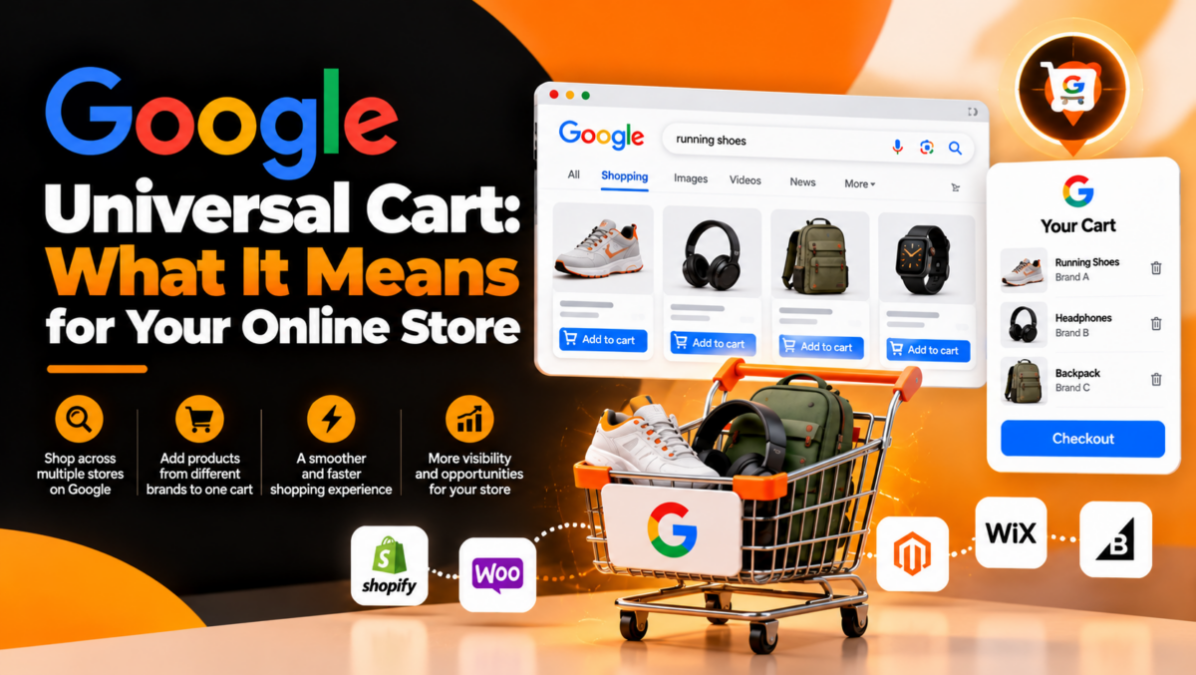
Google wants to be the place where people shop, not just the place where they search for products. On 15 October 2026, it started rolling out Google Universal Cart in the US, a single shopping cart that works across Google Search and the Gemini app.
Shoppers can add products from different stores into one cart, get alerts when prices drop, and pay with Google Pay without opening the store’s website. For anyone who runs a Shopify or WooCommerce store, that last part deserves a closer look.
Here’s what Universal Cart does, who can use it right now, and what store owners in India should keep an eye on.
What is Google Universal Cart?
Google calls it “your new hub for shopping on Google.” In its announcement, Suresh Ganapathy, Senior Director of Product Management for Consumer Shopping, wrote: “Today, Universal Cart is rolling out in the U.S. across Google Search and in the Gemini app.”
Google first showed Universal Cart at its I/O event in May 2026 and said then that it would launch in the US over the summer. It arrived in mid-October.
Quick facts
| Detail | What we know |
|---|---|
| Launched | 15 October 2026 |
| Where | Google Search (including AI Mode) and the Gemini app |
| Countries | US only for now |
| Checkout | Google Pay, or move items to the store’s own cart |
| Named partners | Nike, Sephora, Target, Ulta Beauty, Walmart, Wayfair and “many Shopify merchants” |
| Seller of record | The merchant |
| India | Not announced |
What shoppers can do with it
According to Google and Search Engine Land, Universal Cart lets shoppers:
- save products from several stores in one cart, and see the same cart in Search and Gemini
- get alerts when a saved product drops in price or comes back in stock
- see promo codes and possible card benefits based on the cards in their Google Wallet
- check out with Google Pay at supported stores, or send the items to the store’s own website to finish there
Google says the price and stock information comes from its Shopping Graph, which it describes as having more than 60 billion product listings.
One thing it doesn’t do is buy things automatically. A person still decides when to check out. Google’s agentic checkout, which can complete a purchase for a shopper within a budget, is a separate feature.
Get a professionally designed and developed website tailored to your needs.
As an experienced website developer based in Delhi NCR, I offer customized solutions to build responsive, SEO-friendly, and user-friendly websites. Whether it’s for a personal blog, business site, or e-commerce store, I ensure your online presence stands out.
How checkout works for merchants
This is the part store owners care about most.
When a shopper pays through Google Pay inside the cart, the order still belongs to you. Google says merchants “will remain the seller of record,” so you send the confirmation email, ship the order and handle customer support.
Shoppers can also skip Google’s checkout and move items to your site’s cart instead. PPC Land reports that both routes use the Universal Commerce Protocol (UCP), the open standard Google introduced earlier in 2026 for AI-driven shopping.
What PPC Land found in Merchant Center documentation
PPC Land went through Google’s earlier Merchant Center help pages and reported a few details that matter to merchants:
- Google’s own onboarding started with selected US merchants who filled in an interest form and had products marked with a
native_commerceattribute. - In September 2026, Google began switching on native checkout for Shopify merchants it had matched to their Merchant Center accounts. According to PPC Land, merchants who want orders to stay on their own domain had to turn this off themselves.
- An October help page lists three ways for eligible merchants to take part: send the cart to their own site, use native checkout on Google, or link customer identities.
- Sending carts to your own site needs a UCP profile at
/.well-known/ucpand a recent UCP version.
These details come from PPC Land’s reading of Google’s help pages, not from the launch post itself, so check your own Merchant Center account for the current settings.
Who can use it right now
Only shoppers in the US. Google hasn’t said when other countries will get it. PPC Land reports that an October help page moved Canada and Australia to 2027, and Google said in May that the UK would follow later.
There’s no word on India yet.
Some features shown at I/O are also missing from the launch. YouTube and Gmail support, which Google talked about in May, isn’t mentioned in the launch post, and Google hasn’t said whether those are delayed or dropped.
What this means for Indian store owners
If you only sell in India, nothing changes for you today. But a few things are worth thinking about now.
If you sell to US customers, check your Merchant Center and, if you use Shopify, your checkout settings. Decide whether you’re happy for orders to be placed on Google’s side or whether you want every sale to land on your own site.
Your product data matters more than ever. Universal Cart pulls prices and stock from Google’s Shopping Graph. Wrong prices or out-of-date stock in your product feed means a shopper gets the wrong alert, or none at all. Keep your Merchant Center feed accurate and in sync with your store.
You may see less of the customer journey. When a shopper compares prices and pays inside Google, they spend less time on your site. Retail Dive quoted Wharton professor Kartik Hosanagar on this shift: “Whoever controls the agents now has the power.” Building direct relationships, through email lists, WhatsApp updates and loyalty offers, becomes more important.
WooCommerce stores will probably need UCP support. Shopify handles a lot of this for its merchants. If you run WooCommerce, watch for plugins or Google tools that add a UCP profile. Until then, a clean, fast checkout on your own site is still your best bet.
We wrote about an earlier version of this debate in Shopify Confirms AI Shopping Can’t Bypass Checkout. Universal Cart is the next step: shoppers can now pay on Google’s side, but the merchant still owns the order.
How to get your store ready for AI shopping
You don’t need Universal Cart in India to start preparing. These steps help with Google Shopping, AI Mode and AI agents in general:
- Set up Google Merchant Center and connect your product feed. Shopify and WooCommerce both have official Google integrations.
- Keep prices and stock in sync. Use automatic feed updates instead of manual uploads.
- Add complete product details: GTIN or brand, clear titles, real photos, sizes and colours.
- Use structured data (Product schema) on your product pages so Google can read price, availability and reviews.
- Make your site easy for AI agents to use. Our guide to the Google Lighthouse AI Agent Test shows how to check this.
Here’s a minimal Product schema example you can adapt:
<script type="application/ld+json">
{
  "@context": "https://schema.org/",
  "@type": "Product",
  "name": "Cotton Kurta - Blue",
  "image": "https://example.com/images/kurta-blue.jpg",
  "sku": "KURTA-BLU-M",
  "brand": { "@type": "Brand", "name": "Your Brand" },
  "offers": {
    "@type": "Offer",
    "priceCurrency": "INR",
    "price": "1299",
    "availability": "https://schema.org/InStock",
    "url": "https://example.com/products/cotton-kurta-blue"
  }
}
</script>
Key takeaways
- Google Universal Cart launched in the US on 15 October 2026 across Search and the Gemini app.
- Shoppers can save items from many stores, get price and stock alerts, and pay with Google Pay or on the store’s own site.
- The merchant stays the seller of record and handles orders and support.
- Checkout runs on the Universal Commerce Protocol, and Shopify merchants are among the first partners.
- There’s no date for India, but accurate product feeds and a fast checkout will matter even more when it arrives.
FAQs
It’s a shopping cart inside Google Search and the Gemini app that lets you save products from different stores, track price drops and restocks, and check out with Google Pay or on the store’s website.
Not yet. It launched in the US only, and Google hasn’t announced a date for India.
The merchant. Google says merchants remain the seller of record, so they send confirmations, ship the order and provide customer support.
No. It saves products and sends alerts, but the shopper decides when to buy. Google’s agentic checkout is a separate feature.

Pradeep Maurya is the Professional Web Developer & Designer and the Founder of “Tutorials website”. He lives in Delhi and loves to be a self-dependent person. As an owner, he is trying his best to improve this platform day by day. His passion, dedication and quick decision making ability to stand apart from others. He’s an avid blogger and writes on the publications like Dzone, e27.co