Artificial Intelligence is no longer something we “expect” to happen. It is already part of how we work, whether we notice it or not.
If you’ve used a chatbot for support, an AI tool to write or design something, or software that suggests decisions for you — then you’re already working alongside AI.
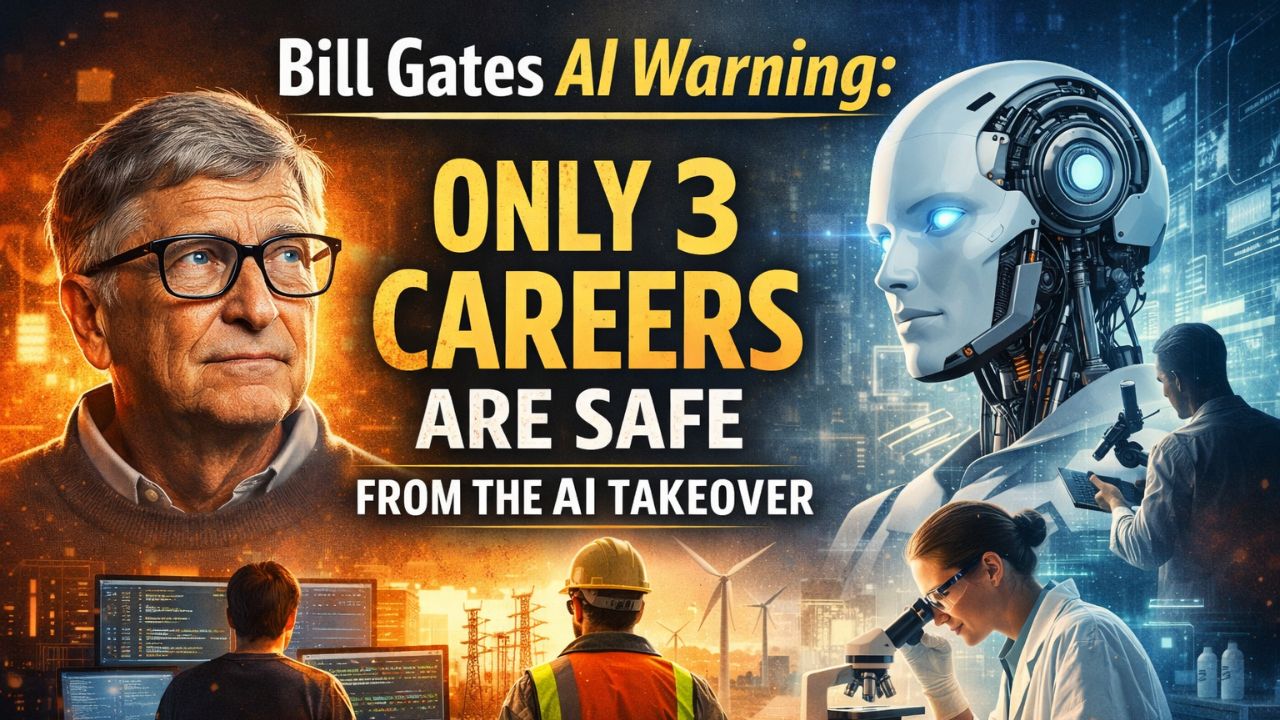
That’s why the Bill Gates AI warning landed so strongly. He didn’t talk about distant futures. He talked about what is already starting.
Most jobs, he said, will either be replaced or heavily changed by AI.
At the same time, he mentioned that a few careers are safer for now. Not permanent. Just slower to change.
So what are they? And what does this actually mean for normal people?
Suggested Read: Is AI Stealing Jobs? Hiring Data Reveals the Truth in 2026
The reality: AI will touch almost every job
This isn’t just happening in tech companies.
AI is quietly entering offices, schools, hospitals, factories, and online businesses.
In many cases, work that once needed a small team can now be done by one person with the right tools.
This doesn’t mean people will suddenly be unemployed. But it does mean job roles will keep shifting. The version of your job today may not exist in the same form five or ten years from now.
The three careers Bill Gates considers safer
1. Software developers and engineers
Yes, AI can write code. That part is already obvious.
But real development is not about typing code. It’s about understanding unclear problems, making design decisions, dealing with changing requirements, fixing things when they break, and thinking about long-term impact.
AI can assist.
It cannot take responsibility.
Developers who use AI wisely are moving faster than ever. Developers who ignore it are slowly being left behind.
Also Read: How to Choose Between WordPress, Shopify, and Custom PHP
2. Energy professionals
This includes people working with power systems, renewable energy, climate technology, and infrastructure.
These jobs deal with physical systems, safety rules, and long-term planning. When mistakes happen here, the consequences are real and immediate.
AI can analyse and suggest improvements. But humans still decide, and humans still carry the risk.
3. Biologists and life science researchers
Biology does not follow clean rules. It is unpredictable and often confusing.
Researchers still need to decide what to study, how to design experiments, how to interpret uncertain results, and how to handle ethical questions.
AI helps with data.
It does not replace judgment.
An important truth people avoid
Even these careers are not truly “safe”. They are simply slower to change.
AI will not remove all jobs. But it will reduce how many people are needed to do the same amount of work.
One person who understands AI can often replace several who do not.
The bigger risk is not AI.
The bigger risk is standing still.
The real future-proof skill
It is not coding, not AI, not any specific tool. It is the habit of learning.
People who keep learning rarely stay unemployed for long. They shift roles, update skills, and find new paths.
People who stop learning usually realise too late that the world moved on without them.
Also Read: Will AI Make or Break Education in 2026? The Real Truth
How to prepare in a realistic way
You don’t need a dramatic plan. You need small, consistent actions.
Learn to use AI tools for basic tasks.
Improve how you communicate and think.
Accept that your job will change, even if you like it today.
Stop searching for a “safe career”.
There is no such thing anymore.
There are only people who adapt, and people who wait.
Final thought
Bill Gates is not predicting the end of work. He is pointing out that work is changing, whether we like it or not. AI is not something that will arrive one day. It is already part of how the world runs.
The real question is simple:
Will you learn to work with it or will you keep working as if nothing has changed?
Because in the long run, the future rarely belongs to the smartest people. It belongs to the ones who were willing to change first.
Vikas Maurya is a professional blogger and Data analyst who writes about a variety of topics related to his niche, including data analysis and digital marketing.