

Last month, my cousin—who is in college—called me at midnight.
Not to talk about exams.
Not to complain about assignments.
He asked something that stuck in my head:
“If AI can write my answers… what’s the point of studying anymore?”
That one question says everything.
Because AI (Artificial Intelligence) is not just changing education.
It is challenging the meaning of learning itself.
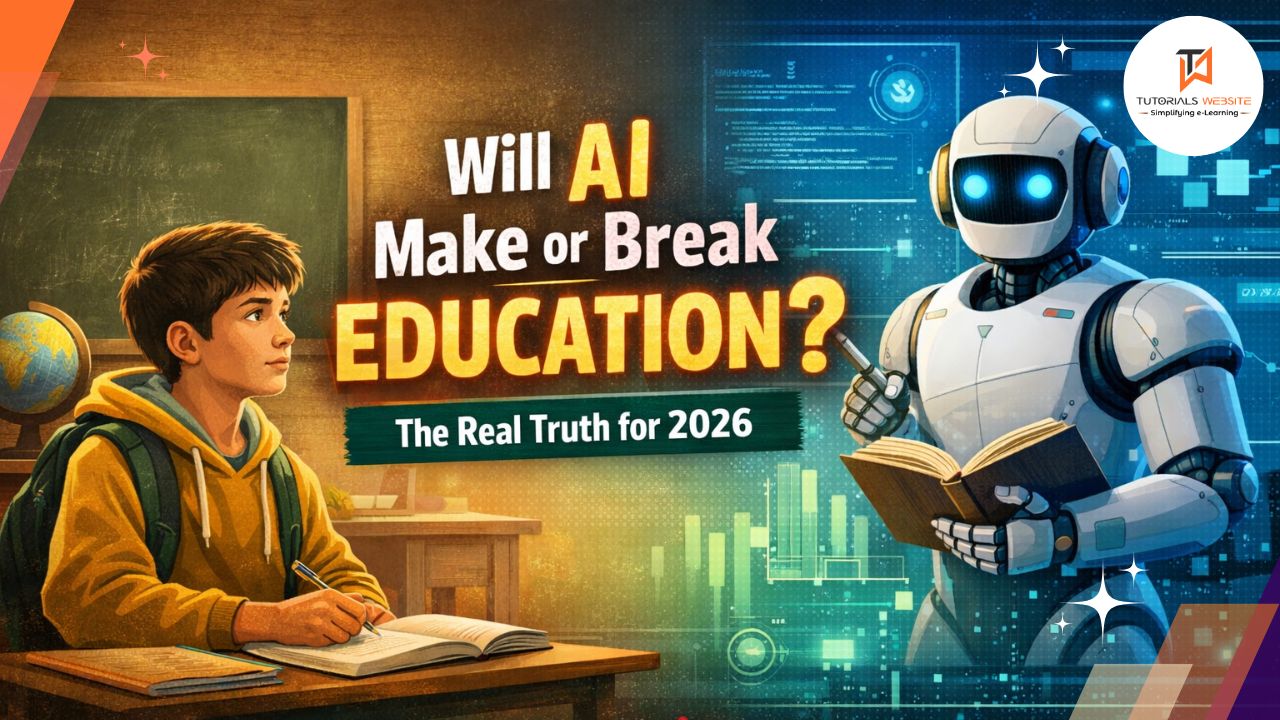
So will AI make education better… or quietly break it?
Let’s talk like real people, not tech headlines.
AI Is Already in Classrooms (Whether We Like It or Not)
Students use AI to:
- Understand hard topics
- Rewrite notes
- Solve problems
- Draft essays
Teachers use AI to:
- Create lesson plans
- Grade faster
- Track student progress
So the question is not if AI belongs in education.
It already does.
The real question is:
Are we using it wisely?
How AI Can Make Education Better
1. Every Student Learns Differently
In a normal classroom, one teacher handles 30–50 students.
A few students learn fast, others struggle to keep up, and some feel too shy to ask questions.
AI can quietly notice these differences and adjust lessons.
Not by replacing teachers—but by supporting them.
This is where AI feels like a gift.
2. No More Waiting for Feedback
Think about how long students wait to know what they did wrong.
AI can show mistakes instantly.
Not with red marks—but with guidance.
That kind of fast correction builds confidence.
3. Teachers Get Their Time Back
Teachers are tired.
Not because of students—but because of paperwork.
AI can take care of routine tasks so teachers can do what they love:
teach.
But Here’s the Scary Part
1. Students May Stop Thinking
If a machine gives answers instantly,
why struggle?
That struggle is where real learning happens.
Without it, education becomes copy–paste.
2. Cheating Becomes Invisible
Earlier, cheating was obvious.
Now it’s silent.
Teachers can’t always tell if work is real or generated.
That hurts trust.
3. Not Everyone Has Equal Access
Some students use paid AI tools.
Some don’t even have laptops.
If we’re not careful, AI will widen the gap.
4. Data and Privacy
Students are still kids.
Their data should never become a product.
But with AI, this risk is real.
So… Will AI Make or Break Education?
Here’s the truth:
AI itself is neutral.
Our choices decide the outcome.
Used wisely → it makes education stronger.
Used blindly → it weakens it.
What We Must Do
- Teach students how to use AI, not avoid it
- Change exams to test thinking, not memory
- Support teachers, not replace them
- Protect student data
- Ensure equal access
Final Thought
AI is not the end of education.
But it is the end of education as we knew it.
When we understand how AI in classrooms should support learning instead of replacing thinking, we stop fearing the technology and start shaping it.
The future of education should not be about answers —
it should be about understanding, creativity, and growth.

Pradeep Maurya is the Professional Web Developer & Designer and the Founder of “Tutorials website”. He lives in Delhi and loves to be a self-dependent person. As an owner, he is trying his best to improve this platform day by day. His passion, dedication and quick decision making ability to stand apart from others. He’s an avid blogger and writes on the publications like Dzone, e27.co

[…] Also Read: Will AI Make or Break Education in 2026? The Real Truth […]