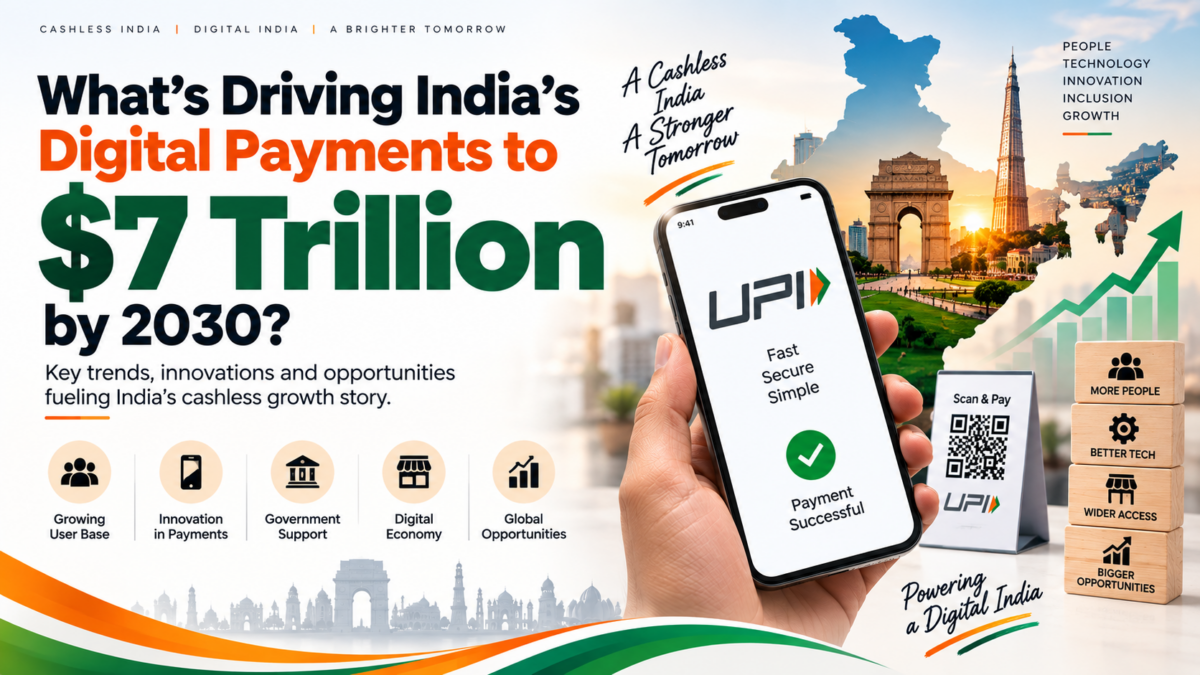
India’s digital payments market is set to double. It will go from $3.6 trillion in FY24 to $7 trillion by FY30, according to a joint study by Kearney and Amazon Pay. That’s a doubling in six years. It comes on top of a market that already grew from $300 billion to $3.6 trillion in the five years before that.
I build ecommerce and payment systems for businesses across India, so numbers like these aren’t abstract to me. They tell me where merchant demand is headed, and which parts of a checkout flow are worth getting right today instead of bolting on later.
How Big Is India’s Digital Payments Market Right Now?
Retail digital payments in India grew from $300 billion in FY18 to $3.6 trillion in FY24. That’s a roughly twelvefold jump in five years.
UPI did most of the heavy lifting. It grew at a 138% compound annual rate in transaction volume over that period. India now accounts for close to half of all digital transaction volume worldwide.
Adoption has also stopped looking like a niche behavior:
- 90% of survey respondents prefer digital payments for online purchases
- 72% is how often both men and women now transact digitally, a near-closed gender gap
- 46% of global digital transaction volume in 2022 came from India alone
What’s Actually Pushing Growth to $7 Trillion?
Three forces are doing most of the work, based on how the report frames it.
1. Aspirational Consumers
Millennials and Gen X are leading adoption across every digital payment instrument, not just UPI. More of India’s population is entering spending age with a smartphone already in hand. Digital becomes the default, not a choice.
2. Government-Led Financial Inclusion
UPI itself came out of a public infrastructure push. Government initiatives keep widening access, especially in Tier 2 and Tier 3 cities. This pulls in first-time digital users who skip cash entirely, rather than transitioning through it.
3. Ecosystem Acceleration
This is the part I watch most closely as a developer. UPI remains the main entry point for digital payments, but credit cards and Buy Now, Pay Later options are increasingly the preferred method for larger purchases. A single payment method is no longer enough on a checkout page.
Why This Matters If You Run a Website or Store
A growing payment market only helps your business if your site is actually built to capture it.
I’ve seen stores lose sales not because customers didn’t want to buy, but because checkout only supported one payment method, or the payment gateway added friction at the exact moment someone was ready to pay.
A modern payment gateway needs to support UPI, cards, wallets, and increasingly BNPL, without slowing down checkout or creating a jarring redirect experience. RBI’s own guidelines on payment gateways and payment aggregators exist precisely because this layer of infrastructure handles sensitive customer data and money in transit, so getting the integration right isn’t optional, it’s foundational.
This is exactly the kind of work I handle through Payment Gateway Integration for WordPress, Shopify, and Laravel stores, connecting the right combination of UPI, cards, and BNPL providers so a business doesn’t lose a sale to a checkout that couldn’t keep up with how Indians actually pay in 2026.
What Smaller Businesses Should Take From This
You don’t need every payment method on day one. But the direction is clear enough to plan around.
Make UPI your default checkout path. It’s still the primary entry point for most Indian consumers, and the fastest way to close a sale.
Add card and BNPL support as your order values climb. The report shows these instruments taking over from UPI specifically for larger purchases.
Treat mobile-first checkout as non-negotiable. The growth numbers above are overwhelmingly mobile transactions.
Plan for reliability under load. A payment gateway that fails during a sale or a festive season spike costs more in lost trust than in lost revenue for that one transaction.
The Bigger Picture: E-Commerce and Payments Are Growing Together
India’s online retail market was valued between $75 and $80 billion in 2022 and is expected to grow at roughly 21% a year through 2030.
Digital payments and e-commerce are pulling each other forward, and a business sitting outside that loop with a clunky or limited checkout is going to feel it more with every year that passes.
Final Words
The $7 trillion figure by 2030 isn’t a far-off prediction anymore. It’s the continuation of a trend that’s already run its course once, from $300 billion to $3.6 trillion, and shows no real sign of slowing down.
FAQs
Retail digital payments in India are projected to reach $7 trillion by FY30, up from $3.6 trillion in FY24, according to a study by Kearney and Amazon Pay.
Three main factors: aspirational consumers adopting digital-first habits, government-led financial inclusion initiatives expanding access in smaller cities, and an accelerating ecosystem where cards and BNPL are gaining ground alongside UPI for larger purchases.
Yes. UPI grew at a 138% compound annual rate in transaction volume between FY18 and FY24 and remains the primary entry point for most digital payments, though cards and BNPL are increasingly preferred for higher-value transactions.
A larger digital payments market only translates into more sales if a business’s checkout can actually support how customers want to pay. That means offering UPI as the default option while adding card and BNPL support as average order values grow, backed by a reliable payment gateway integration.
India accounted for around 46% of global digital transaction volume in 2022, making it one of the largest and fastest-growing digital payments markets in the world.

Pradeep Maurya is the Professional Web Developer & Designer and the Founder of “Tutorials website”. He lives in Delhi and loves to be a self-dependent person. As an owner, he is trying his best to improve this platform day by day. His passion, dedication and quick decision making ability to stand apart from others. He’s an avid blogger and writes on the publications like Dzone, e27.co