


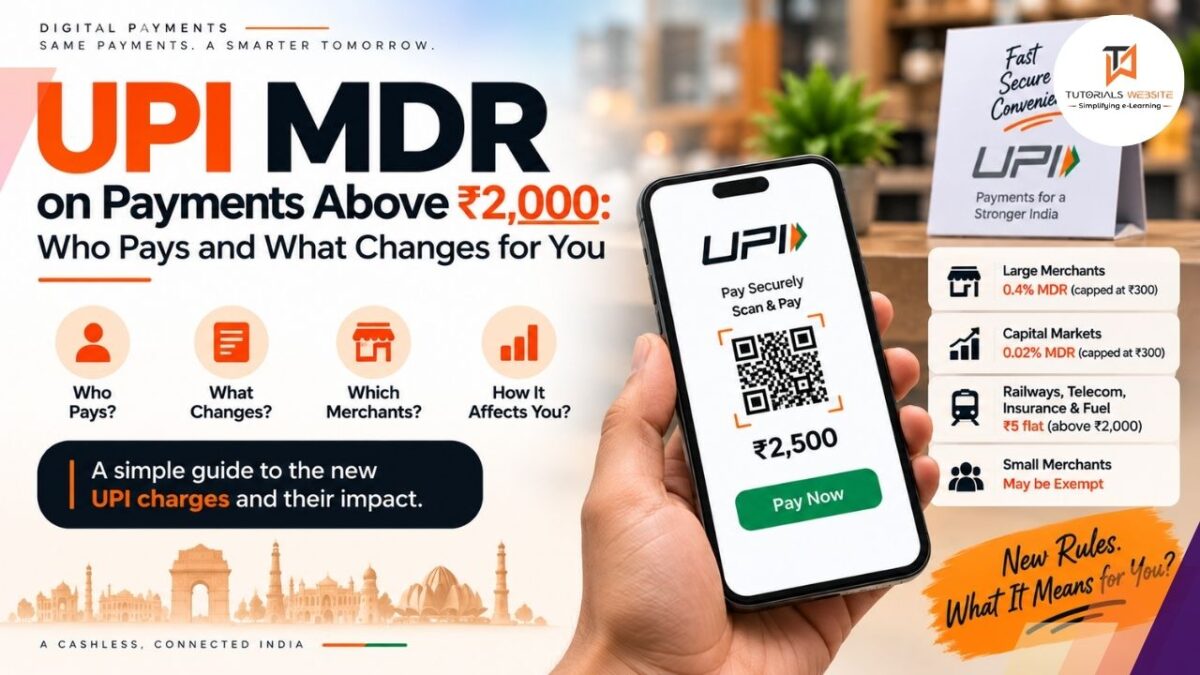
NPCI announced this week that UPI transactions above ₹2,000 will now carry a Merchant Discount Rate (MDR) of 0.4%, starting October 15, 2026. If you run a business that accepts UPI, or you just pay for things with it every day like most of us do, here’s what actually changes and what doesn’t.
What is MDR, in plain terms
MDR is the small fee a bank charges a merchant every time a customer pays digitally. When you swipe a credit card at a shop, the shop pays a cut to the bank behind the scenes, not you. UPI has run on zero MDR since 2020, which is a big part of why every chai stall in the country now has a QR code taped to the counter.
What’s actually changing on October 15
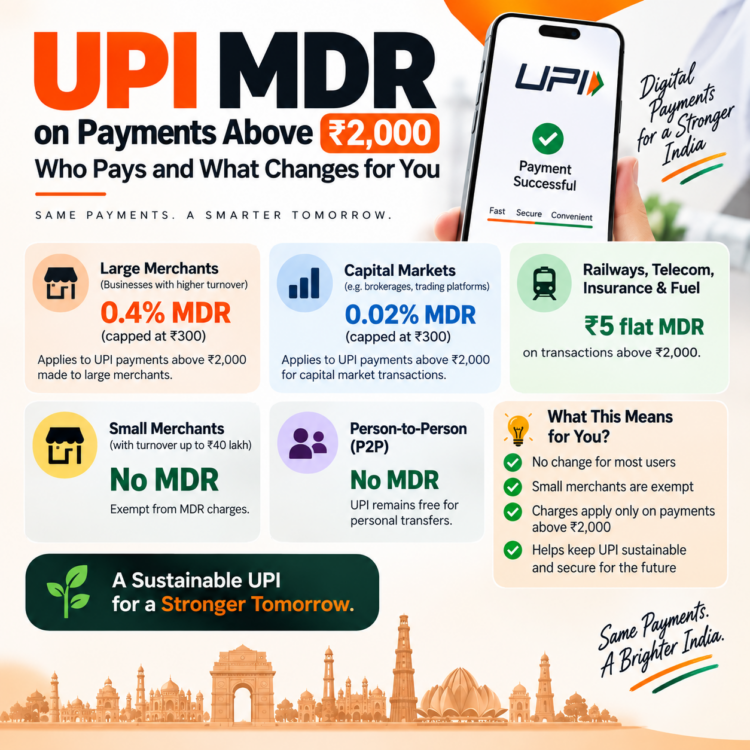
Any UPI payment from a customer to a merchant (what NPCI calls a P2M transaction) above ₹2,000 will now attract a 0.4% MDR, capped at ₹300 per transaction. So on a ₹3,000 purchase, the merchant pays ₹12. On a ₹50,000 purchase, ₹200. Once the bill crosses ₹75,000, the fee stops growing and stays fixed at ₹300, no matter how large the transaction gets.
That’s the headline number, but the fine print matters more than the number itself.
Who actually pays this fee
Not you, at least not directly. The MDR is charged to the merchant, not the customer, and NPCI has been explicit that merchants aren’t allowed to pass it on by inflating prices. Banks have also been told to make sure merchants don’t quietly add a “UPI surcharge” at checkout the way some places used to do with credit cards.
Whether that holds up in practice is a different question, and I’ll come back to it.
What stays completely free
A lot, actually. This is the part most headlines skip past.
- Person-to-person payments — sending money to friends, family, or splitting a bill — stay free, always, regardless of amount.
- Any P2M payment of ₹2,000 or under stays free. NPCI says this covers more than 95% of all UPI merchant transactions by volume, so most day-to-day spending isn’t touched at all.
- Small merchants under the P2PM category — street vendors and small shops receiving up to ₹1 lakh a month via UPI QR into their personal accounts — continue on zero MDR no matter how many ₹2,000+ payments they take.
- Recurring payments set up via UPI AutoPay, like OTT subscriptions or SIP mandates, aren’t affected either.
The exceptions inside the exception
A few sectors get their own flat-fee treatment instead of the 0.4% rate. Railways, telecom, insurance, and fuel payments above ₹2,000 attract a flat ₹5 per transaction, regardless of how big the bill is. Fill your tank for ₹4,000 and the fee is still ₹5, not ₹16.
Capital market transactions, meaning mutual funds, stock trading, and broker top-ups, get an even lower rate: 0.02%, capped at ₹300. A ₹1 lakh mutual fund purchase through UPI costs the broker ₹20 in MDR. If you’re an active trader moving money in and out often, this is worth knowing, even if the per-transaction cost sounds small.

Why this is happening now
UPI processed 2,451 crore transactions worth nearly ₹30 lakh crore in August 2026 alone. Running that kind of infrastructure, the servers, fraud detection, bank integrations, isn’t free, and it’s been funded mostly through annual government subsidies that were never meant to be permanent. NPCI’s argument is that a small, predictable fee on higher-value merchant transactions gives the ecosystem a sustainable funding model instead of relying on the budget every year. Part of the collection is also earmarked for a fund to expand UPI access for small merchants in Tier 3 and smaller towns.
What merchants are actually saying
Not everyone’s convinced. A LocalCircles survey of over 32,000 merchants found that only 17% are willing to absorb a 0.4% MDR without pushing back in some way, and 41% said they wouldn’t want to bear any MDR at all. The Confederation of All India Traders has cautiously backed a “nominal” MDR on high-value transactions but wants to see how it plays out before fully endorsing it. Retailers seem more anxious about this than quick commerce or large e-commerce platforms, who say the impact on their margins is minor.
So while the rule says merchants can’t pass this cost to you, plenty of small business owners are openly saying they’ll try, one way or another, whether that’s a small price bump, a “cash preferred” nudge at checkout, or quietly steering high-ticket customers toward other payment methods.
What this means if you run a website or store
If you’re a business owner who takes UPI payments on your site, this is worth a five-minute conversation with whoever manages your payment gateway before October 15. Check how your gateway calculates and displays MDR on high-value UPI orders, and decide now whether you’re absorbing that cost or building it into pricing, rather than figuring it out mid-checkout in November. I build and maintain payment integrations for clients across WordPress, Shopify, and Laravel stores, and this is exactly the kind of change that’s easy to miss until a customer complains about a fee they didn’t expect.
For everyday users, the short version is this: your ₹150 coffee, your rent split with a roommate, your ₹1,800 grocery run, none of it changes. It’s the ₹40,000 laptop or the ₹1 lakh gold purchase where a merchant now quietly pays a bit more to accept your UPI payment, and where it’s worth watching whether that cost finds its way back to you anyway.
FAQs
No. The MDR is a merchant-side cost, not a customer charge. You keep paying the listed price, whether you’re sending ₹500 or ₹50,000.
No. Person-to-person transfers, including self-transfers between your own accounts, stay free of cost with no limit on how often you use them.
Nothing changes. NPCI says these make up over 95% of all UPI merchant payments, so the vast majority of everyday spending is untouched.
No, as long as they fall under the P2PM category, meaning they receive up to ₹1 lakh a month through UPI QR into their own account. Cross that threshold consistently for three months and a vendor moves into the regular P2M category, where the 0.4% rule applies above ₹2,000.
No. Existing QR codes, soundboxes, and payment setups keep working exactly as they do now. There’s no re-registration or hardware update required.
Once a transaction crosses ₹75,000, the MDR stops scaling with the 0.4% rate and locks at ₹300 flat. A ₹1,00,000 payment would work out to ₹400 at the straight percentage, but the cap brings it down to ₹300.
No. Mandates for subscriptions, SIPs, and utility auto-debits don’t carry this MDR.
No, merchants are barred from passing the MDR on to customers as a separate charge. Whether every business actually follows that in practice is a fair thing to stay alert to, especially on high-value purchases.
October 15, 2026. Nothing changes before that date.


Nidhi Maurya is a professional blogger and Content Writer who writes about a variety of topics related to his niche, including Web Tech, SEO, and digital marketing.


