


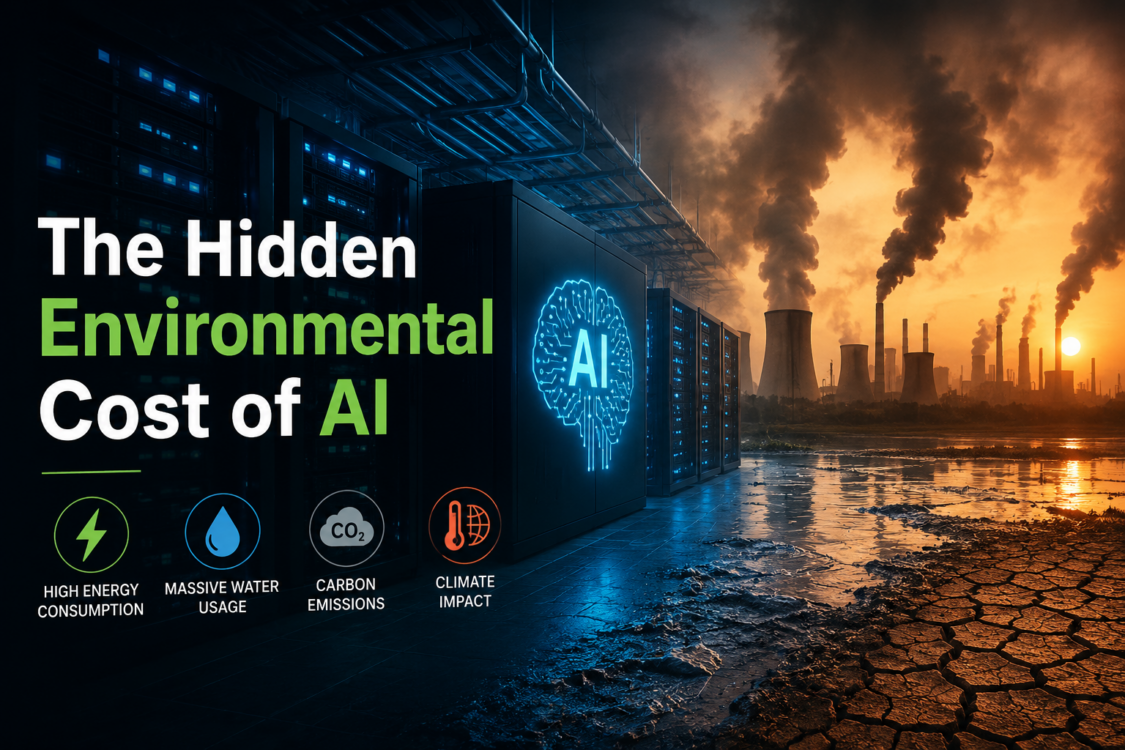
Everyone’s talking about what AI can do. Almost nobody’s talking about what it takes to run it. That gap is the real story here, and it’s bigger than most people realize.
Every time someone types a prompt into a chatbot, a server somewhere lights up, draws power, and generates heat that has to go somewhere. Multiply that by a few billion prompts a day, and you start to see the actual scale of what we’re building.
Not a single dramatic event, but a slow, steady squeeze on resources that most people never think about because the interface in front of them is just a text box.
The data center boom is real, and it’s not slowing down
Tech companies aren’t just buying GPUs, they’re buying land, water rights, and sometimes entire power plants. Building an AI data center isn’t like building a normal office or warehouse.
These facilities need server racks stacked floor to ceiling, industrial cooling systems, and electrical substations that can handle loads closer to a small city than a single building.
The pace of construction right now is unlike anything the tech industry has done before, and it’s happening in places that weren’t built to support it.
Electricity is the first thing to break
Training and running large AI models eats power at a rate that traditional computing never approached. A single query to a large model can use several times the electricity of a regular web search.
Grid operators in places like Virginia, Texas, and Ireland are already flagging that they can’t keep up with requests coming in from data center developers. Some utilities have started telling new projects to wait, because the local grid simply doesn’t have the headroom.
Water is the part nobody talks about
This is probably the most underdiscussed angle of the whole story. Cooling a data center takes water, sometimes millions of gallons a day for a single large facility. In places already short on water, that creates a direct conflict between keeping AI servers cool and keeping local communities supplied. It’s not abstract. Arizona and parts of India are already dealing with this tension between industrial water use and agricultural or residential need.
Climate change makes the whole problem worse
Here’s the part that compounds everything else: as the planet heats up, cooling those same data centers gets harder and more expensive. Hotter summers mean more energy spent just keeping the hardware from overheating, which means more electricity demand, which means more strain on a grid that’s already stretched. It’s a feedback loop, and not a good one.
Solar and wind can’t cover the gap, at least not yet
Renewable energy is growing fast, but it’s not growing fast enough to match how quickly AI’s power demand is climbing. Solar and wind also aren’t always available exactly when a data center needs constant, round-the-clock power. That mismatch is pushing companies to look elsewhere, and nuclear power has come back into the conversation in a way that would’ve seemed unlikely five years ago. Microsoft, Google, and Amazon have all signed deals or made investments tied to nuclear power specifically to run AI infrastructure.
The conversation is lopsided
Most of what gets written about AI focuses on what it can do: write code, generate images, answer questions faster than a search engine. Almost none of it touches what it costs to keep that running. That imbalance is the real issue here. People are excited about the output and ignoring the plumbing behind it.
This needs actual planning, not just enthusiasm
Governments are going to have to think seriously about power generation, water management, and where new infrastructure gets built, because right now a lot of this is happening reactively. Companies are racing to add capacity, and regulators are playing catch-up. That’s not a great formula for managing something this resource-intensive.
None of this means AI should stop
AI isn’t bad, and nobody needs to abandon the technology. But growth has to come with real investment — clean energy, smarter cooling methods, and infrastructure that can actually support demand without draining the systems around it. Innovation without that balance just shifts the cost onto someone else, usually whoever’s grid or water supply happens to be closest to the nearest data center.
Nobody is hiding AI’s environmental cost. It stays hidden because it spreads out gradually, and people ignore it until the cracks show up in places where they actually live.


Nidhi Maurya is a professional blogger and Content Writer who writes about a variety of topics related to his niche, including Web Tech, SEO, and digital marketing.


