


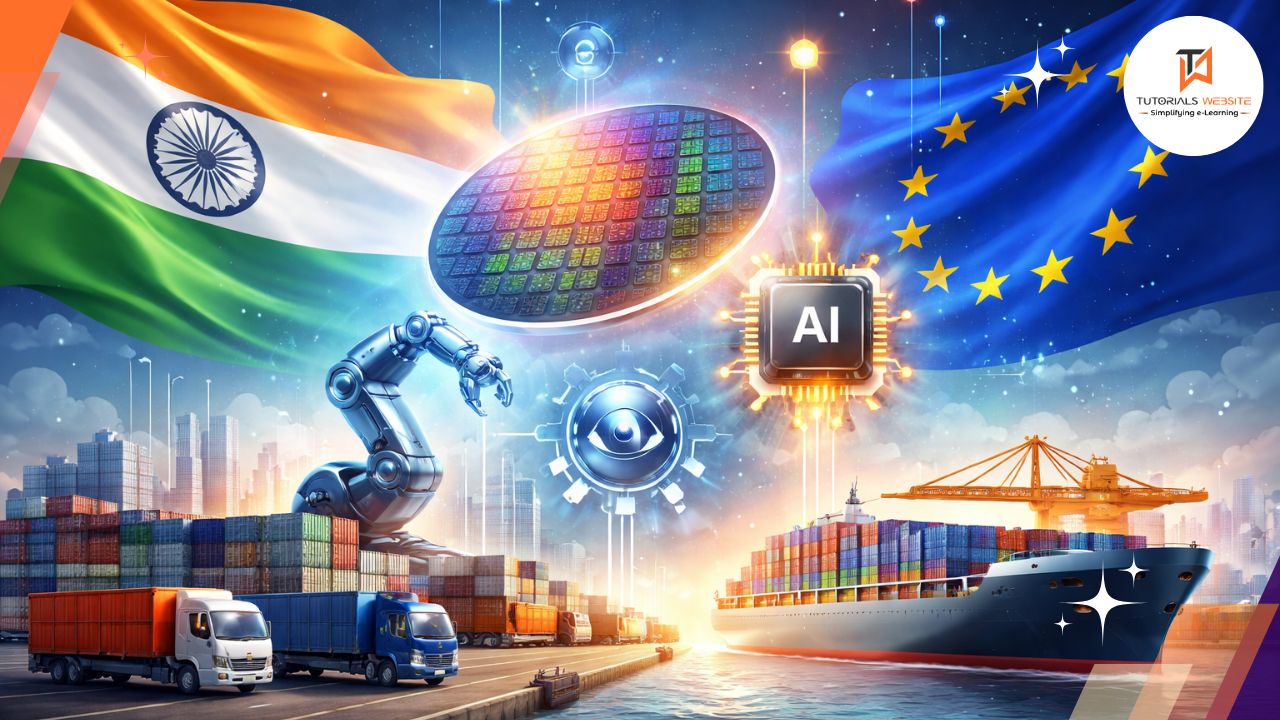
When India and the European Union announced their Free Trade Agreement (FTA) on 27 January 2026, most headlines focused on cars, wine, textiles, and tariffs. But quietly, this deal also touched two areas that matter far more in the long run: artificial intelligence (AI) and semiconductors.
These technologies don’t usually sit at the centre of trade discussions, yet they shape almost everything we use today. From smartphones and electric vehicles to hospitals and defence systems, AI and chips are now core economic assets. That’s why this agreement deserves attention beyond traditional trade talk.
Why This Trade Deal Is Different
This agreement isn’t just about selling more goods to each other. It reflects how the global economy has changed. Today, value comes from:
- software and digital services
- research and innovation
- advanced manufacturing
That’s why the India–EU FTA includes areas like digital trade, technology cooperation, and long-term investment. For India, this matters because future growth depends less on low-cost labour and more on high-value technology.
Semiconductors: The Missing Piece India Needs
India has talked a lot about building its own semiconductor industry. The challenge isn’t talent — India has plenty of engineers. The real problem is access to very specialised machines needed to make chips.
Most of this equipment is made in Europe.
If the FTA reduces trade barriers:
- importing chip-making equipment becomes cheaper
- projects become easier to fund
- manufacturing timelines improve
This doesn’t mean India suddenly becomes a chip powerhouse. But it removes some of the biggest roadblocks that slow everything down.
Suggested Read: Future of AI Led by Smaller Models, Says Union Minister Vaishnaw
Why Europe Fits Well Into This Picture
Europe isn’t trying to compete with India in large-scale manufacturing. Instead, it brings experience — decades of work in chip design, precision tools, and industrial electronics.
India brings scale: a large market, a growing tech ecosystem, and skilled engineers.
The FTA encourages both sides to work together through:
- direct European investment in India
- joint ventures instead of one-sided outsourcing
- shared research and development
That’s how semiconductor ecosystems actually grow — slowly, through cooperation.
How This Helps India’s AI Industry
AI isn’t just about writing code. Behind every AI system are powerful chips and reliable computing infrastructure.
The India–EU FTA helps AI growth in indirect but important ways:
- Indian AI companies get better access to European markets
- collaboration on research becomes easier
- common standards reduce regulatory headaches
For startups and IT firms working in healthcare, finance, manufacturing, or automation, Europe is a tough but valuable market. Easier access can make a real difference.
A Quiet Push for Stronger Supply Chains
Recent global disruptions showed how risky it is to depend on a small number of countries for semiconductors. When supply chains break, entire industries feel it.
This is where the India–EU partnership becomes practical:
- Europe reduces its dependence on limited suppliers
- India moves closer to global manufacturing networks
- both sides gain more stability
It’s not about speed. It’s about reliability.
The Strategic Angle Most People Don’t Notice
There’s also a long-term strategic reason behind this agreement. Both India and the EU want more control over where their critical technologies come from.
They share concerns around:
- secure access to chips
- data governance
- technology independence
Working together on AI and semiconductors helps address these concerns without cutting ties with the global economy.
What This Could Mean Over Time
If the agreement is implemented properly, the impact will show gradually:
- semiconductor projects become easier to sustain
- more high-skill tech jobs are created
- foreign investment becomes long-term, not speculative
- India slowly shifts from tech services to tech production
This is not a quick win. It’s a direction change.
Final Thought
The India–EU Free Trade Agreement won’t change everything overnight. It won’t dominate headlines every day. But it quietly sets the stage for deeper cooperation in AI and semiconductors — two areas that will shape economic power in the years ahead.
Sometimes, progress in technology begins not with innovation, but with better rules.
Also Read: Is AI Stealing Jobs? Hiring Data Reveals the Truth in 2026


Vikas Maurya is a professional blogger and Data analyst who writes about a variety of topics related to his niche, including data analysis and digital marketing.