


OpenAI launched ChatGPT Wallet on Friday, 13 November 2026, and it changes what ChatGPT can do for shoppers. Until now, ChatGPT could research products, compare prices and suggest what to buy, but you still had to visit the store and pay yourself. ChatGPT Wallet lets the company’s AI agents, called dots, finish the job by paying for the purchase on your behalf, after you approve it.
The wallet is built with American Express, Mastercard and Visa. It uses payment tokens, so the agent and the store never see your real card number, and it asks for a biometric check before every single purchase. For now it is open only to a small group of ChatGPT Pro users in the United States.
This post explains what ChatGPT Wallet is, how a purchase works from start to finish, the security behind it, who can use it today, why OpenAI built it, what it means for online stores, and where India stands on AI agent payments.
What is ChatGPT Wallet?
ChatGPT Wallet is a digital wallet inside ChatGPT that stores your payment card for AI agents to use. You add a card once. After that, when your agent has found a product and prepared an order, it can pay through the wallet instead of asking you to type card details into the store’s checkout page.
OpenAI describes it as a secure way for agents in ChatGPT Work, Codex and dots to complete purchases with user approval and existing card protections. The first rollout is through dots. According to OpenAI’s announcement, 1.2 billion people use ChatGPT every week, and many of them already use it to research products, compare options and decide what to buy. The company says the wallet helps people complete those purchases, and gives their agents a way to pay that businesses can accept with the systems they already have.
OpenAI calls it the first payment wallet designed to let AI agents make transactions without accessing a user’s actual card information.
How ChatGPT Wallet works

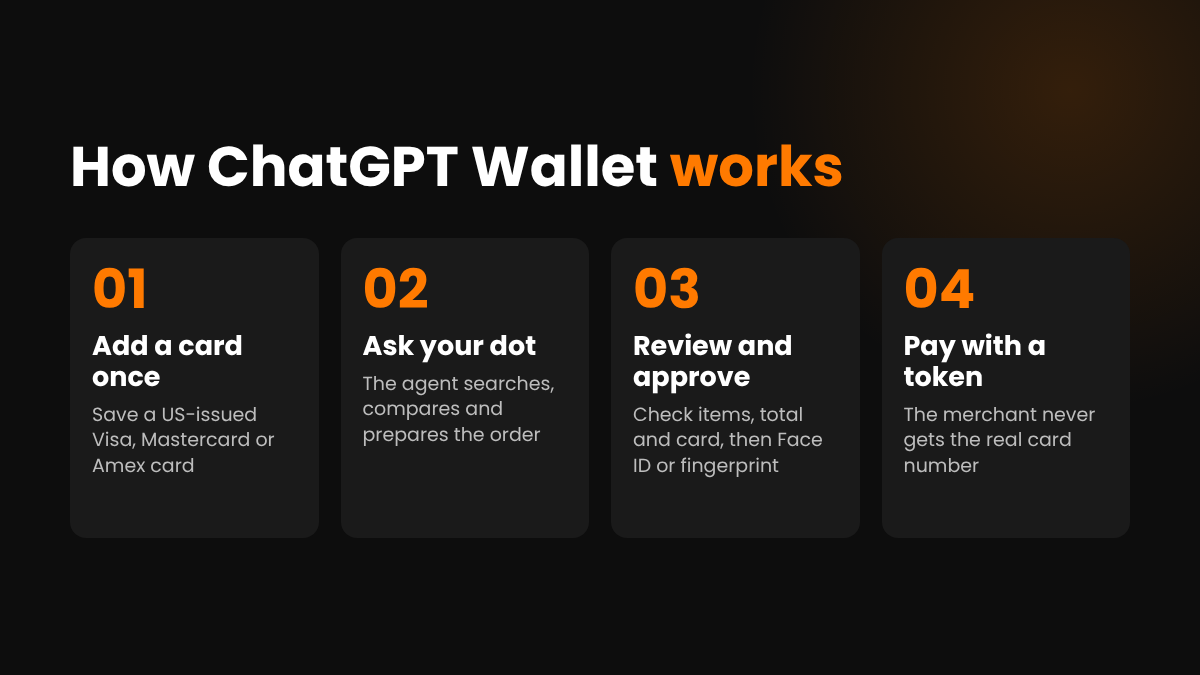
A purchase through ChatGPT Wallet follows four steps.
1. You add a card once
The first step is a one-time setup. You add an eligible Visa, Mastercard or American Express card to ChatGPT Wallet. You don’t have to enter your payment details again each time you buy something.
2. Your dot finds the product
You ask your dot to help with a purchase. The agent searches the web, compares options and prepares the order. It also passes the store the details it needs to fulfil the order, such as your shipping address and contact information.
3. You review and approve
Before checkout, ChatGPT shows you the items, the total amount and the card it will charge. You approve the purchase with a biometric check, such as Face ID or a fingerprint scan. Nothing gets bought until you give this approval, and each approval creates a transaction record.
4. A payment token completes the payment
Once you approve, the card network issues a payment token, and your card is charged through that token. The token takes the place of your real card number, so ChatGPT Wallet never shares the actual card details with the store or with the agent.
How ChatGPT Wallet keeps your card safe
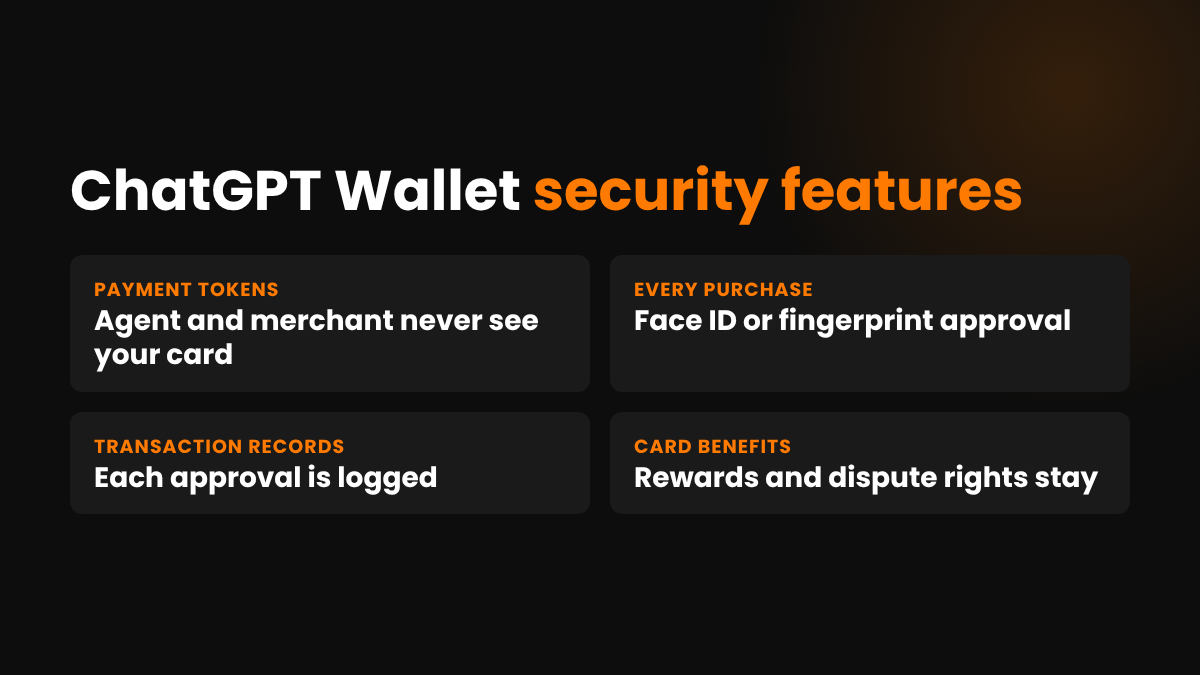
Payments are the most sensitive thing an agent can do, so OpenAI has built several layers of protection into the wallet:
- Payment tokens. Every payment uses a token instead of the card number. Neither the dot nor the merchant ever receives your real card details, which removes the biggest risk of handing payments to software.
- Approval for every purchase. The agent cannot complete a purchase on its own. You must confirm each one with Face ID or a fingerprint after seeing the items, total and card.
- Transaction records. Each approved purchase is recorded, so you can check what your agent bought and when.
- Card rewards stay. You keep earning the points, cashback or other rewards your card already offers.
- Card protections stay. If a charge is wrong, you can dispute it with your bank or card issuer, just as you would with any other card purchase.
The card networks have backed this approach. American Express said it is bringing the trust, security and control of its payments into new AI-powered shopping. Mastercard’s Sherri Haymond, global head of digital commercialization, said an agent’s purchase should “strengthen, not bypass” the trust built into payments. Chaya Nayak, OpenAI’s head of product for monetization and payments, told CNBC the company wants to put merchants and network partners first while building a secure, easy-to-use foundation.
Who can use ChatGPT Wallet right now?
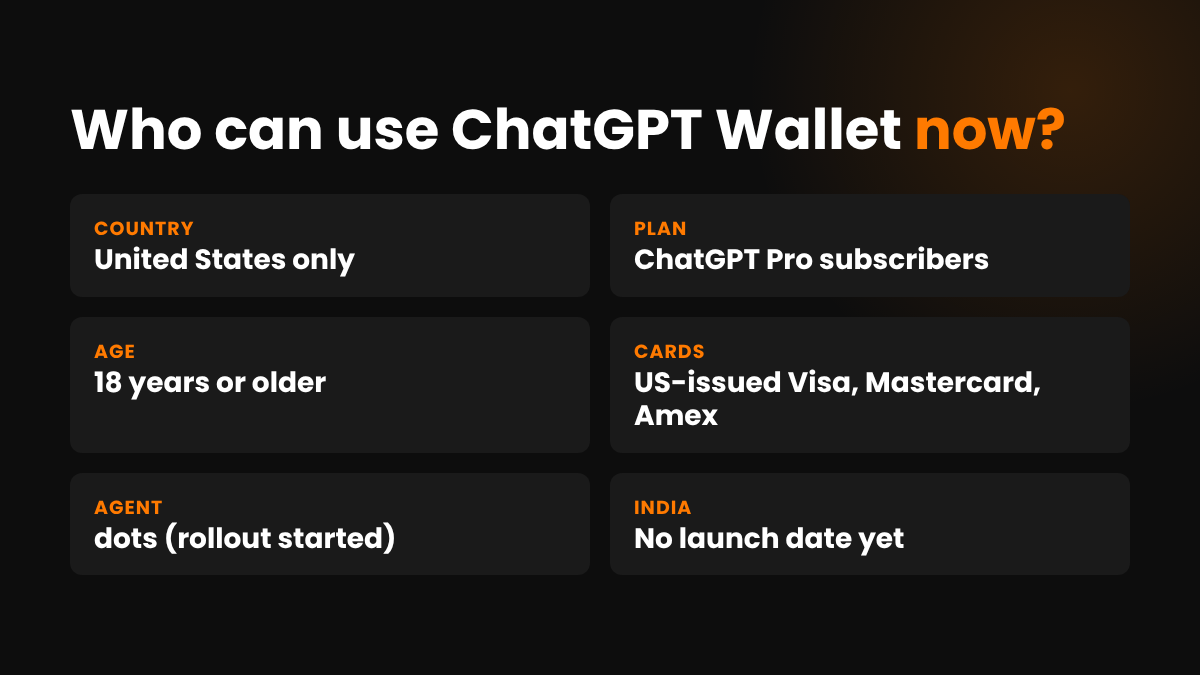
The rollout is deliberately small. According to TechCrunch, you need to meet all of these conditions:
- You live in the United States.
- You have a ChatGPT Pro subscription.
- You are 18 years or older.
- You have a US-issued Visa, Mastercard or American Express card.
Even among eligible users, only a limited number get the feature in the first wave. OpenAI has said agentic commerce is still in its early days and that many websites and payment systems are still adapting to agents, which is why it is starting with ChatGPT Pro subscribers in the US.
What are dots?
Dots are the AI agents that use ChatGPT Wallet first. OpenAI launched them at its DevDay event on 29 September 2026. They are always-on personal agents that run on the GPT-6 Astra model. Each dot has its own cloud computer and browser, can connect to more than 4,000 apps, and keeps working on a task after you close the chat.
Dots are included with ChatGPT’s Pro plans, which start at $100 a month, and with Business Premium and Enterprise plans. At launch, OpenAI made dots available to Pro users outside the European Economic Area, Switzerland and the UK. That means some Pro users in India can already use dots, but they cannot use ChatGPT Wallet yet, because the wallet only accepts US-issued cards.
Why OpenAI built ChatGPT Wallet
ChatGPT Wallet is OpenAI’s second serious attempt at shopping inside ChatGPT.
The first came on 29 September 2025, when OpenAI launched Instant Checkout with Stripe and its Agentic Commerce Protocol. It let US users buy certain products without leaving ChatGPT. In March 2026, OpenAI changed direction. It said the original design did not give merchants enough flexibility, and it moved to a model where merchants keep their own checkout, accounts and loyalty programs.
In August 2026, the tech site RuntimeWire found an unreleased “Introducing ChatGPT Wallet” screen in the code of ChatGPT’s Windows app, along with secure card-entry screens. The feature that launched on 13 November matches that discovery.
The new wallet solves the problem the first attempt ran into. Merchants don’t have to rebuild their checkout, because the wallet’s payment tokens work with the checkout flows they already use. OpenAI only supplies the secure payment credential that the agent needs.
Competition is another reason. Meta’s personal agent, Muse, which has more than 10 million users, already helps people shop, and AI-assisted shopping is one of the most popular things people do with it. Other agents, such as Instinct, also support purchases. A wallet gives ChatGPT’s agents a way to keep up.
What ChatGPT Wallet means for online stores
For anyone running an online store on WooCommerce, Shopify, Magento or a custom PHP or Laravel setup, AI agents are becoming a new kind of customer. They read product pages, compare options and now pay, so a store that agents cannot read or check out from will miss these sales.
Some big retailers are blocking agents
Not every retailer is welcoming agents. TechCrunch reports that Amazon is the largest retailer to ban AI agents from its site, because it wants shoppers to use its own agent, Alexa, instead. Delivery companies such as DoorDash and Uber have also reported low order volumes from AI agents so far. For smaller stores that do allow agents, this is a chance to pick up sales that the biggest players are turning away.
OpenAI’s Commerce Partner Playbook
Alongside the launch, OpenAI published a Commerce Partner Playbook to help businesses get ready for agent shoppers. It covers three areas:
- Product information. Make product details available in a form agents can read clearly.
- Agent access. Make sure websites do not block legitimate agents by mistake.
- Payments and risk. Work with payment and risk providers so real purchases made by agents are not declined or cancelled as suspected fraud.
OpenAI warns that even though the wallet’s tokens work with existing checkout flows, risk systems may still flag legitimate agent purchases. That is the most likely reason an agent’s purchase would fail.
What Indian developers and store owners can do now
The wallet is not live in India yet, but the groundwork for agent shoppers is the same everywhere:
- Keep product titles, prices and stock status clear and up to date on every product page.
- Add structured data (schema markup) so agents can read product details accurately.
- Review your Cloudflare, firewall or security plugin bot rules so legitimate agents are not blocked.
- Test your site with Google Lighthouse’s AI agent test.
- Check the fraud and risk settings of your payment gateway, whether you use Razorpay, Cashfree, PhonePe or another provider.
Shopify merchants should also read our posts on why ChatGPT checkout adds an extra 4% fee and why AI shopping can’t bypass checkout.
When will ChatGPT Wallet come to India?
OpenAI has not announced a launch date for India or any other country outside the US. The wallet currently works only with US-issued cards. OpenAI has said it will work with businesses, banks and payment networks to learn from early use and then expand availability.
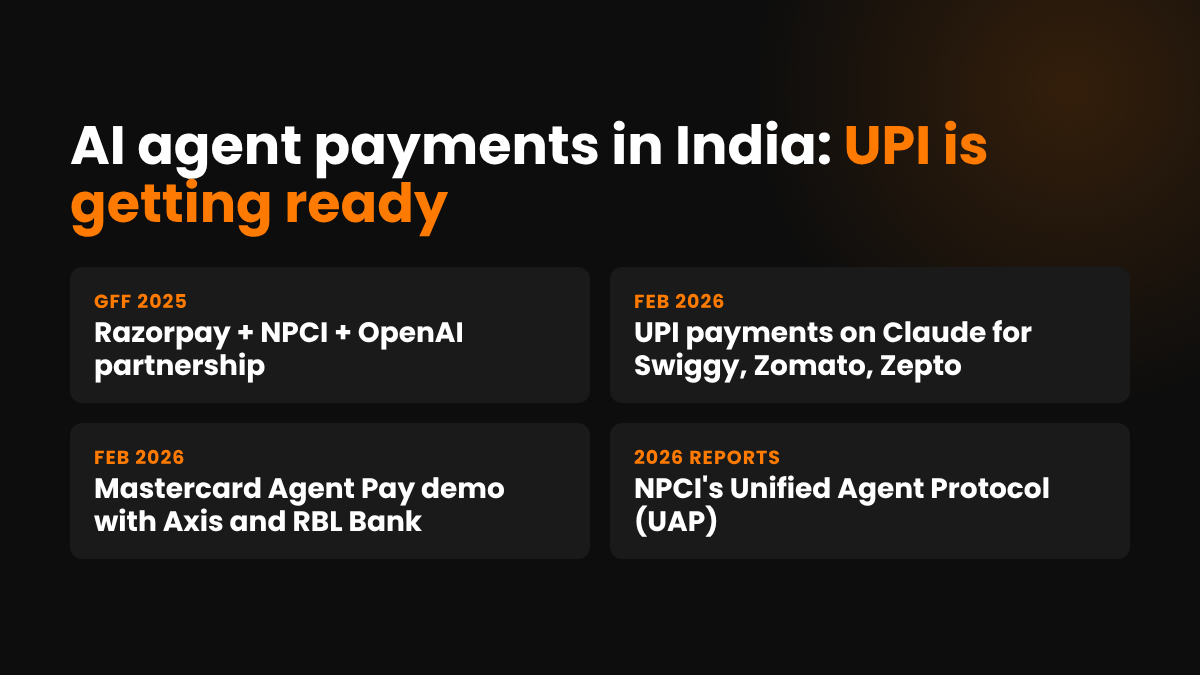
India, however, is not starting from zero. The country has been building AI agent payments on UPI for over a year:
- At Global Fintech Fest 2025, Razorpay announced a partnership with NPCI and OpenAI to bring agentic payments to ChatGPT in India.
- In February 2026, Razorpay and NPCI launched UPI-powered agentic payments on Anthropic’s Claude, with Zomato, Swiggy and Zepto as the first partners.
- Also in February 2026, Mastercard demonstrated India’s first authenticated agentic transaction at the India AI Impact Summit, using its Agent Pay framework with Axis Bank and RBL Bank.
- In 2026, reports said NPCI is developing a Unified Agent Protocol (UAP), a standard to register, verify and authorise AI agents to make UPI payments.
The scale of UPI makes this especially important. UPI processed 23.66 billion transactions worth ₹29.88 lakh crore in July 2026. If AI agents become a standard way to pay on a system that size, the impact in India could be larger than in the US. For more on recent UPI changes, read our explainer on MDR for UPI payments above ₹2,000.
What’s next for ChatGPT Wallet
OpenAI has outlined how the wallet will grow:
- Spending limits. Users will be able to set rules by purchase category or time period.
- Pre-approved purchases. Agents will be able to complete some purchases within limits you set, without asking you every time, backed by stronger safeguards.
- More retailers. OpenAI plans to support a wider range of stores.
- Wider availability. More users and more regions, after OpenAI learns from the first rollout.
Our take
The first version of ChatGPT Wallet gets the basics right. Asking for Face ID or a fingerprint on every purchase keeps people in control, and payment tokens mean a leak from an agent or a store cannot expose your card number. Keeping card rewards and dispute rights also means you give up nothing by paying this way.
The harder questions will come with pre-approved purchases. Once an agent can buy without asking each time, people will want clear answers on refunds, wrong orders and who is responsible when something goes wrong. Shoppers seem to share that caution. A PYMNTS Intelligence report found consumers are happy to let agents do research but much less comfortable handing over payment choices or decisions they can’t undo. For a wider look at keeping AI agents in check, see our post on Nvidia OpenShell. When the wallet does reach India, starting with small, low-risk purchases is the sensible approach.
FAQ
ChatGPT Wallet is OpenAI’s payment feature for AI agents, launched on 13 November 2026. You save a card in it, and ChatGPT’s agents (starting with dots) pay for purchases on your behalf after you approve each one.
Not yet. It is currently limited to ChatGPT Pro users in the US who are 18 or older and have a US-issued Visa, Mastercard or American Express card. OpenAI has not announced a date for India.
No. Every payment uses a payment token in place of your card number, so neither the agent nor the store receives your real card details.
Not at present. You see the items, total and card before every purchase and approve it with Face ID or a fingerprint. OpenAI plans to add optional pre-approved purchases with spending limits later.
Yes. OpenAI says existing card rewards and protections, including the right to dispute a charge, continue to apply.
US-issued Visa, Mastercard and American Express cards.
OpenAI has not announced a separate fee for the wallet. You need a ChatGPT Pro subscription, which includes dots.
What do online stores need to do to accept ChatGPT Wallet payments?
Stores don’t need a new checkout system, because the wallet’s tokens work with existing checkout flows. They should make sure their site doesn’t block legitimate agents and that their payment risk rules don’t decline genuine agent purchases. OpenAI’s Commerce Partner Playbook covers the details.
Conclusion
ChatGPT Wallet moves ChatGPT from suggesting products to buying them. The first version is careful: it uses payment tokens, requires biometric approval for every purchase, keeps card rewards and protections, and is limited to a small group of US Pro users. Spending limits, pre-approved purchases and more retailers are on the way. India will have to wait for an official launch, but the work already done on agentic UPI payments means the country is well prepared when it comes. Online store owners can start getting ready today by making their sites easy for AI agents to read and buy from.


Pradeep Maurya is the Professional Web Developer & Designer and the Founder of “Tutorials website”. He lives in Delhi and loves to be a self-dependent person. As an owner, he is trying his best to improve this platform day by day. His passion, dedication and quick decision making ability to stand apart from others. He’s an avid blogger and writes on the publications like Dzone, e27.co


